Treatment of lagophthalmos — incomplete eyelid closure from facial nerve palsy or Bell's palsy — to protect the cornea and restore function.
Medically reviewed by EyePlastics Medical Editorial BoardASOPRS oculoplastic surgeonsLast updated June 2026
Lagophthalmos is incomplete or absent closure of the eyelids. When the eyelid cannot fully close, the cornea and conjunctiva are exposed to evaporation, drying, and trauma — leading to exposure keratopathy that can progress from punctate erosions to corneal ulceration, scarring, and permanent vision loss.
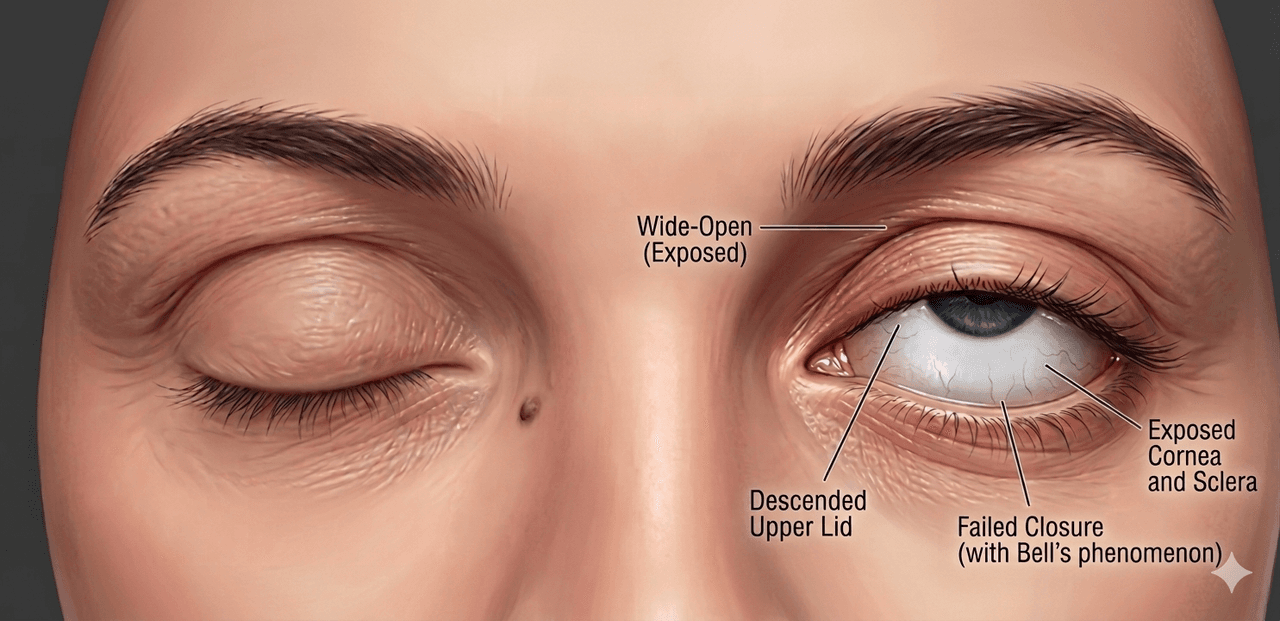
The severity of corneal exposure depends on three factors: the degree of lagophthalmos (how many millimeters the eye fails to close), the blink rate (which spreads the tear film), and the quality of tear film (lubrication). Bell’s phenomenon — the normal reflex that rotates the eye upward on attempted closure — provides some protection, but its presence does not eliminate exposure risk.
For a detailed guide to eyelid anatomy, see our dedicated Anatomy Overview page.
Lagophthalmos results from either neuromuscular failure of eyelid closure or mechanical restriction that prevents closure despite intact muscle function.
Facial nerve palsy is the most common cause. The facial nerve supplies the orbicularis oculi muscle — the muscle that closes the eyelid. Paralysis produces lagophthalmos (failed closure), ectropion (lower lid sag), brow ptosis, and loss of the normal blink reflex.
Clinical evaluation quantifies the degree of exposure and assesses corneal risk:
Treatment is stratified by the severity of lagophthalmos, the expected duration (temporary vs. permanent palsy), and the degree of corneal compromise. The goal is to restore a functional tear film over the entire corneal surface with every blink.
All patients with lagophthalmos require lubrication therapy. The protocol is escalated based on severity:
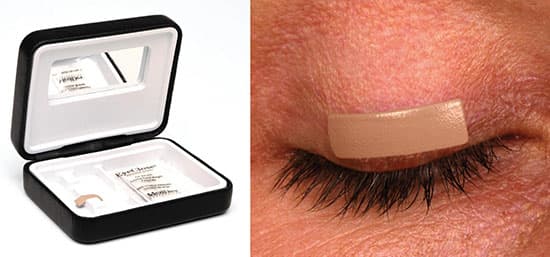
External gold or platinum weights (0.6–2.0 g) can be taped to the pretarsal skin of the upper lid to supplement lid descent. They are used to identify the optimal weight before implantation, to test patient tolerance, and as a temporizing measure while awaiting nerve recovery. They are not practical for long-term use.
Surgery is indicated when medical management fails to prevent corneal progression or when the lagophthalmos is expected to be permanent. The timing is individualized — for Bell’s palsy, most surgeons wait 6–12 months for potential spontaneous recovery before committing to permanent procedures.
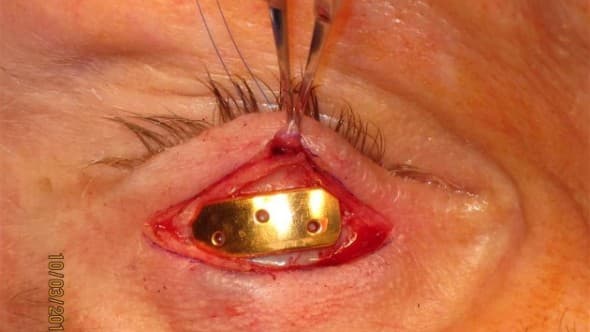
Gold weight implantation is the most commonly performed procedure for paralytic lagophthalmos. A precisely calibrated weight (gold or platinum, 0.6–2.0 g — selected by preoperative external weight testing) is placed in the pretarsal space of the upper eyelid through a lid-crease incision. The weight augments gravity-assisted lid descent; as the patient relaxes the levator, the weight closes the lid.
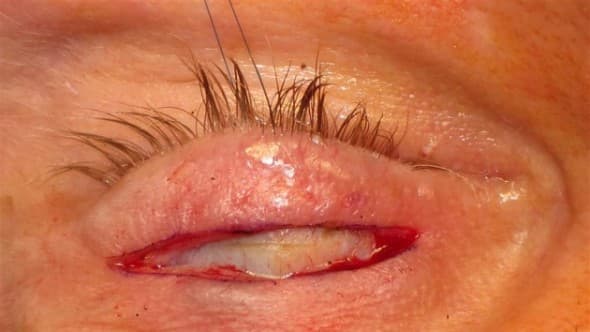
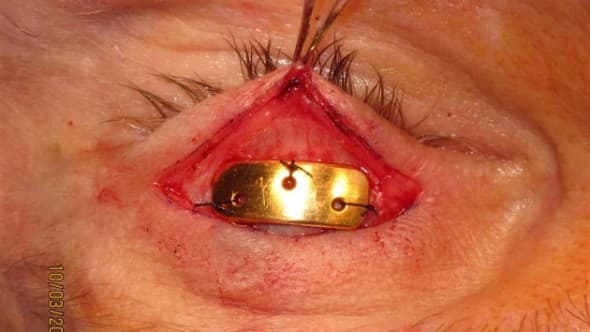
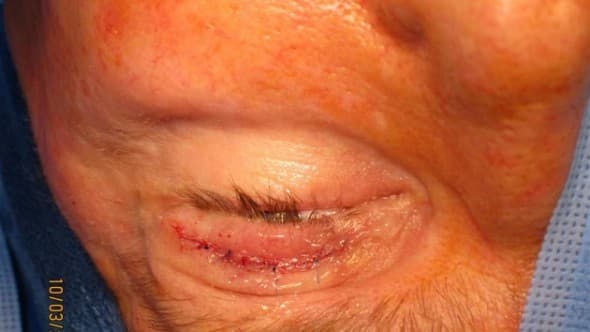
Tarsorrhaphy narrows the palpebral fissure by suturing the upper and lower lid margins together at the lateral canthus (lateral tarsorrhaphy) or, rarely, medially. It is the most durable and reliable procedure for corneal protection but is the most visually and cosmetically disruptive.
Facial nerve palsy often produces concurrent lower lid ectropion and scleral show that worsens exposure. Lower lid procedures may be combined with upper lid loading:
In severe or long-standing facial nerve palsy, the lower lid undergoes progressive ectropion and descent due to orbicularis weakness, gravity, and denervation atrophy of the midface. This creates a wide palpebral fissure that cannot be fully protected by upper lid procedures alone. A comprehensive treatment plan typically addresses both lids: upper lid weight (or, less commonly, a palpebral spring) for closure, and lower lid canthoplasty or spacer graft for support.
Connect with a board-certified oculoplastic surgeon who specializes in lagophthalmos.
Search the Directory →Oculoplastic Surgery — Patient Education
Lagophthalmos