Treatment of eyelid cysts — chalazion and hordeolum (stye) — with warm compresses, intralesional steroid injection, and incision and curettage (I&C).
Medically reviewed by EyePlastics Medical Editorial BoardASOPRS oculoplastic surgeonsLast updated June 2026
Part of our complete guide to Eyelid & Orbital Infections — this page covers chalazion and stye in depth.
A chalazion is a chronic, sterile lipogranulomatous cyst that forms within the eyelid from obstruction and subsequent rupture of a meibomian gland. When meibomian gland secretions become inspissated (thickened) and cannot drain normally through the gland orifice, the gland ruptures internally, releasing lipid material into surrounding eyelid tissue. The body's immune response to this foreign lipid produces a granulomatous inflammatory reaction — the chalazion.
Chalazion is a benign eyelid lesion — part of the broader spectrum of eyelid skin tumors. See Benign Eyelid Lesions within the Skin Tumors section for related conditions including xanthelasma, molluscum contagiosum, and papilloma. Chalazia are closely linked to Blepharitis and MGD; recurrent chalazia warrant evaluation for Rosacea and — in older patients — biopsy to exclude sebaceous cell carcinoma.
These two common eyelid lesions are frequently confused:
Chalazion
Hordeolum (Stye)
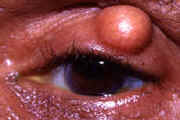
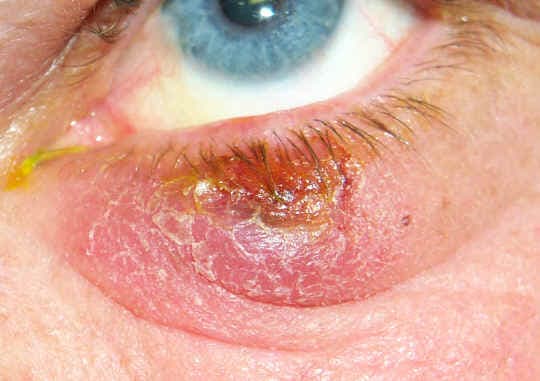
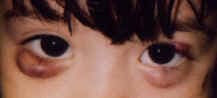
A chalazion presents as a painless or mildly tender firm nodule within the upper or lower eyelid, typically in the mid-lid away from the margin (distinguishing it from the margin-based stye). The overlying skin is normally mobile. On everting the eyelid, a localized, yellowish or pale elevation of the tarsal conjunctiva is seen at the site of the involved meibomian gland.
Large chalazia may:
When to suspect something else: A lesion that recurs in the same location after proper treatment, is accompanied by loss of eyelashes, or has an atypical appearance (irregular, firm, non-mobile) should be biopsied. Sebaceous cell carcinoma — a malignant tumor of meibomian glands — can masquerade as a recurrent chalazion and carries significant morbidity if diagnosis is delayed.
Many chalazia resolve with conservative treatment, particularly early lesions:
Injection of triamcinolone acetonide (0.05–0.2 mL of 10–40 mg/mL) directly into the chalazion is an effective office treatment with resolution rates of 50–80%, avoiding surgery. The injection may be administered transconjunctivally (through the everted eyelid) or transcutaneously (through the eyelid skin).
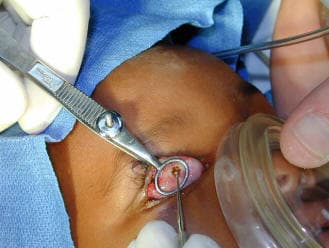
Incision and curettage is the definitive surgical treatment for chalazia that fail conservative management or intralesional steroid injection. The procedure is performed in clinic under local anesthesia:
Resolution is achieved in >90% of cases. Recurrence at the same site after proper I&C should prompt biopsy to exclude sebaceous cell carcinoma.
Patients who develop multiple chalazia or experience rapid recurrence after treatment should be evaluated for:
Children with chalazia should be evaluated for staphylococcal lid disease and treated with conservative management first; I&C in children often requires general anesthesia.
Connect with a board-certified oculoplastic surgeon who specializes in chalazion.
Search the Directory →Oculoplastic Surgery — Patient Education
Lagophthalmos