Double eyelid surgery — creating or enhancing a supratarsal crease in Asian eyelids using non-incisional suture or incisional techniques.
Medically reviewed by EyePlastics Medical Editorial BoardASOPRS oculoplastic surgeonsLast updated June 2026
Asian blepharoplasty — commonly called "double eyelid surgery" — is one of the most commonly performed cosmetic procedures worldwide. It creates or enhances a supratarsal crease ("double eyelid") in patients who lack one or have a low, incomplete, or asymmetric crease. The goal is a natural-appearing eyelid that preserves the patient's ethnic identity while achieving a more defined, open appearance.
Asian blepharoplasty requires intimate knowledge of the differences between Asian and non-Asian eyelid anatomy. The aesthetic goals often differ substantially from Western upper blepharoplasty — a high crease that looks natural on Caucasian eyelids may look foreign or "operated" on an Asian eyelid. See also Blepharoplasty and Anatomy Overview for reference.
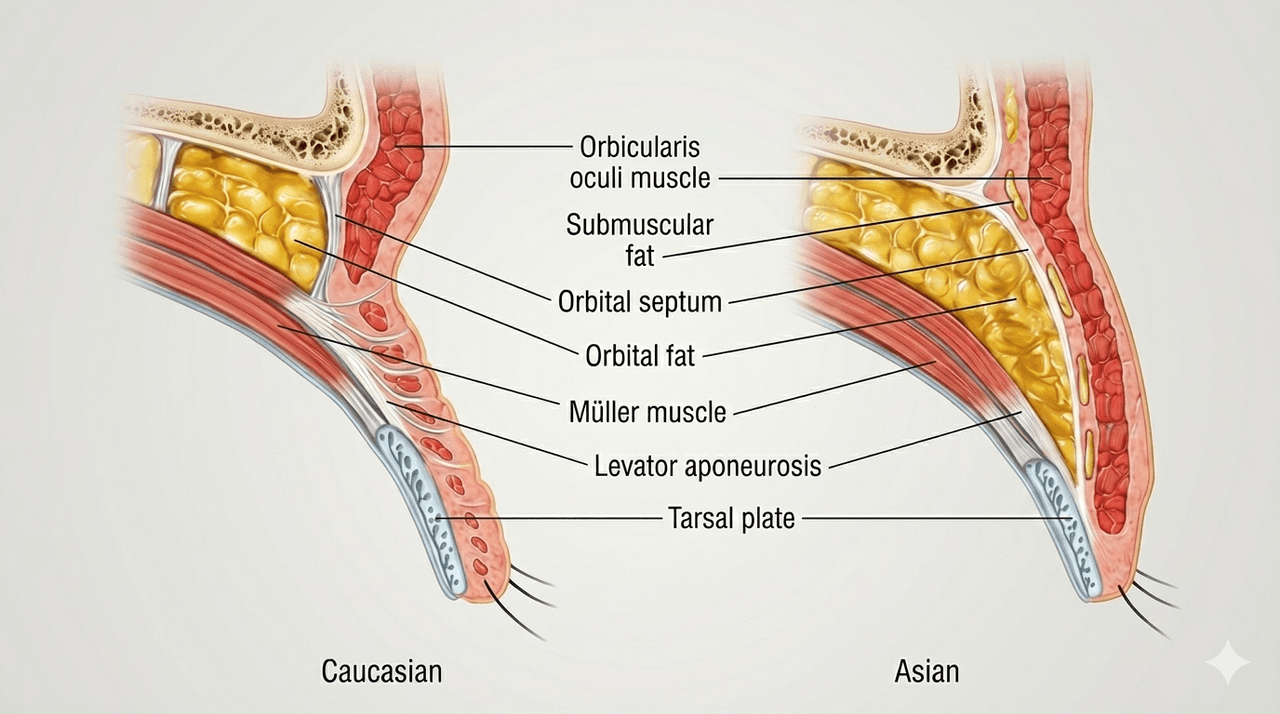
The defining anatomical difference between Asian and non-Asian eyelids lies in the attachment of the levator aponeurosis — the tendon of the muscle that opens the eye — to the skin and pretarsal orbicularis:
Non-Asian (Western) Eyelid
Asian Eyelid
Asian eyelid crease configuration varies considerably among individuals:
The desired outcome of Asian blepharoplasty must be individualized to the patient:
The non-incisional technique creates a crease using buried sutures that replicate the levator-to-skin attachment without excising skin:
The incisional technique creates a durable crease through a skin excision along the planned crease line:
Advantages: Durable, more reproducible result; allows precise crease height and shape; fat removal possible; suitable for all lid types including those with excess skin or fat.
Recovery: 7–14 days of swelling and bruising. Final crease appearance stabilizes over 3–6 months as swelling resolves and the crease softens.
A hybrid approach using two to three short incisions (rather than a full-length incision) to allow fat removal and crease formation with less extensive dissection. Less morbidity than full incision; more durable than suture technique.
The epicanthal fold — a skin fold at the medial canthus — is common in Asian individuals and may obscure the medial crease or give the eye a narrow appearance. When the epicanthal fold is prominent, epicanthoplasty is performed concurrently with double eyelid surgery:
Unsatisfactory results from prior Asian blepharoplasty — including a crease that is too high, too low, asymmetric, or an unnatural-appearing "Westernized" result — are among the most challenging cases in oculoplastic surgery. Revision requires careful analysis of the existing anatomy, scar tissue, and prior operative details. Conservative, staged revision is generally preferred over aggressive re-operation.
Connect with a board-certified oculoplastic surgeon who specializes in asian blepharoplasty.
Search the Directory →Oculoplastic Surgery — Patient Education
Lagophthalmos